The STS-01 category of drones is one of the most important options for professional operators wishing to fly in populated areas within the pilot’s line of sight.
From 2026, the former national STS-ES scenarios will be definitively replaced by the standard European scenarios, and this will bring about changes to key aspects such as the type of drone permitted, the operational declaration, the necessary training and the documentation that must be carried during each operation.
In this guide, I explain what STS-01 is, how it differs from the previous STS-ES-01, what requirements the operator must meet, what the pilot needs, and when an operation no longer fits this scenario and requires a specific operational authorisation.
Comparativa rápida: categoría abierta, STS-01 y STS-02
Categoría abierta
Para operaciones de menor riesgo, con limitaciones más estrictas y sin necesidad de declaración operacional si se cumplen sus condiciones.
STS-01
Operaciones VLOS en entorno poblado, sobre zona terrestre controlada y con UAS de clase C5.
STS-02
Operaciones BVLOS en entorno escasamente poblado, sobre zona terrestre controlada y con UAS de clase C6.

What is the STS-01 Specific Category for drones?
The specific category of STS-01 drones is a standard European scenario defined in Implementing Regulation (EU) 2019/947 and applied in Spain under the criteria of AESA as the competent authority.
This scenario allows for operations with drones that:
- They fall under the specific category, not the open category of drones.
- They are carried out in VLOS (within the pilot’s visual range).
- They take place in populated areas.
- They are developed in a controlled terrestrial area.
- They are covered by an operational declaration, without the need for prior individual authorisation.
The objective of STS-01 is to provide a predefined and standardised operational framework for operations that present a higher level of risk than that permitted in the open category, but sufficiently limited so as not to require an individual SORA analysis.
Difference between STS-01 and the former STS-ES-01 as of 1 January 2026
Until 31 December 2025, Spain permitted operations under standard national scenarios, such as the well-known STS-ES-01, which many pilots used for flights in urban environments.
It could be said that the European STS-01 marks a more demanding and professionalised phase within the specific category of drones.
From 1 January 2026:
- STS-ES certificates are no longer legally valid. This means that any EAROs you hold, issued before 1 January 2026 by the various types of air service providers operating in Spain—such as ENAIRE, SAERCO and Skyway—are no longer valid as of today. This means you must renew your EAROs, whether they are open-category or specific-category certificates. Please ask me for a quote.
- Only European Standardised Scenarios (STS) may be used.
- The equivalent scenario for urban flights in VLOS becomes exclusively STS-01.
¿Necesitas preparar nuevos EAROs para tus operaciones?
Si vas a adaptar tu actividad, actualizar procedimientos o preparar documentación para operar con drones de forma profesional, puedo ayudarte a revisar tu caso y elaborar unos EAROs claros, completos y adaptados a tu tipo de operación.

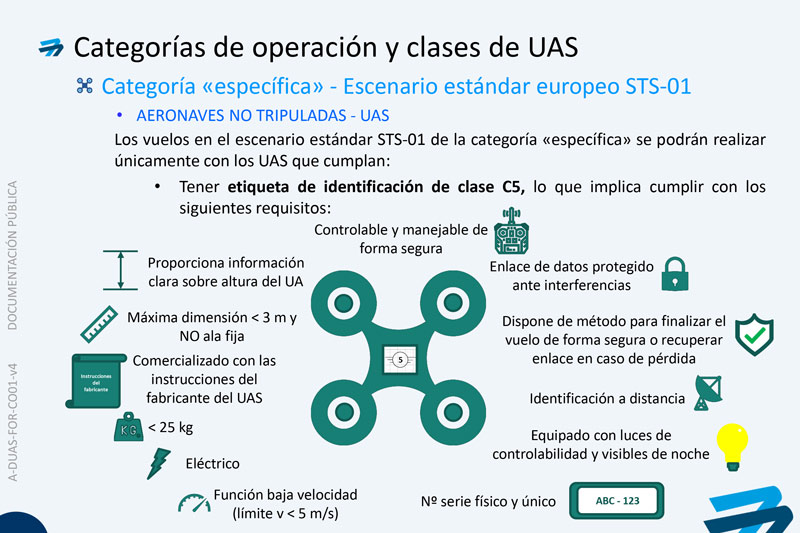
We will now only be able to fly drones classified as Class C5, whereas previously we could fly drones with lower class classifications, which were therefore more affordable.
Do you know which drone has the C5 class rating we need to fly in STS-01?
Common errors when operating STS-01
Although STS-01 facilitates certain professional drone operations, it is also one of the scenarios where the most mistakes are made due to a misinterpretation of the regulations. Many operators believe that simply because they have advanced training or a powerful drone, they are already eligible to operate under a specific category, but this is not the case.
1. Confusing STS-01 with the open category
STS-01 is not an open category. It is a specific category. This entails more requirements, more documentation and greater operational control. If an operation exceeds the limits of the open category, this does not automatically mean that it can be carried out under STS-01: it must fit the conditions of the standard scenario exactly.
2. Thinking that any drone will do for STS-01
To operate on STS-01, the UAS must be marked as Class C5. Using a drone without this marking, or equipment that is not properly documented, may result in the operation falling outside the standard framework.
3. Failure to correctly demarcate the controlled land area
The controlled ground area is a key part of STS-01. It is not enough simply to choose a launch site and take off. The area where the operation is taking place must be controlled to prevent unauthorised persons from entering the danger zone.
4. Failing to check the airspace before the flight
A common mistake is to plan an operation without checking for restrictions, UAS-designated areas, nearby aerodromes, heliports, protected areas or temporary notices. Before operating, it is advisable to check the ENAIRE Drones map and confirm whether any restrictions apply.
5. Confusing an operational declaration with an operational authorisation
If the operation falls exactly within the scope of STS-01, the operator may submit an operational declaration. However, if the operation falls outside the scope of the scenario, a declaration alone is no longer sufficient: a specific operational authorisation based on a risk assessment may be required.
6. Not having clear operating procedures
In STS-01, the operator must have defined procedures in place. This includes how the operation is prepared, how the area is monitored, what to do in the event of an emergency, how the team is coordinated, and how the decision is made to cancel or continue a flight.
7. Failing to draw up a contingency plan
The contingency plan is not merely a formality. It must take into account real-world scenarios: loss of signal, the presence of non-participants, drone failure, changes in weather conditions, loss of GNSS signal, or the inability to maintain the planned conditions.
8. Using STS-01 for operations that are not suitable
Not all urban or professional operations fall under STS-01. If there are special conditions, increased risk, a complex environment or requirements that go beyond the standard scenario, a different operational approach may be required.
Case study: example of an STS-01 operation in an urban environment
Let’s imagine a company that needs to capture aerial footage of a building located in an urban area. The aim is to produce a promotional video of the property, featuring controlled flights around the façade and wide shots of the surrounding area.
At first glance, it might seem like a straightforward operation, but as it is being carried out in a populated area, it is no longer sufficient to simply apply the basic rules of the open category. The operator must assess whether the operation falls within the scope of STS-01.
1. Initial review of the operation
The first step would be to check the purpose of the flight, the exact location, the planned altitude, the type of drone, the presence of bystanders and any airspace restrictions.
It would also be necessary to check whether the flight will take place within the pilot’s line of sight. For STS-01, the operation must be VLOS, meaning that the remote pilot must maintain direct visual contact with the drone throughout the flight.
2. Checking the drone
To qualify under STS-01, the drone must be classified as Class C5. Simply using a professional drone is not sufficient if it does not have the appropriate documentation, a declaration of conformity and meet the applicable technical requirements.
3. Control of the land area
Before flying, the operator would need to establish a controlled ground zone. This may involve marking out the area, having support staff on hand, preventing unauthorised persons from entering, and designating a safe zone for take-off, landing and emergencies.
En una calle, plaza, urbanización o entorno con tránsito de personas, esta parte es especialmente importante. Si no se puede controlar la zona, la operación puede dejar de encajar en STS-01.
4. Airspace review
Before the flight, you must check the airspace and verify whether there are any restrictions, UAS-restricted areas, proximity to airports or heliports, or active warnings. If the area requires additional coordination or authorisation, this must be arranged prior to the operation.
5. Preparation of documentation
The operator should have the STS-01 operational declaration, operational procedures, drone documentation, pilot training records, contingency plan and evidence of flight planning ready.
6. Final decision
If the flight remains within VLOS, the ground area can be monitored, the drone is a C5, the pilot has completed the required training and there are no restrictions preventing the operation, it could be considered an operation under STS-01.
Si alguna de esas condiciones no se cumple, habría que valorar otra vía, como una autorización operacional específica.
Why does this type of flight belong to the specific category and not to the open category?
A transaction falls into the specific category when it does not meet the low-risk conditions required by the open category.
The open category is designed for flights:
- With very limited risk on land.
- No need to control the environment.
- With clear restrictions on proximity to people and populated areas.

In contrast, an operation under STS-01:
- It is carried out in populated areas.
- Requires active risk management on the ground.
- Requires the definition and control of a controlled land area.
- Clearly exceeds the operating limits of A1, A2 or A3.
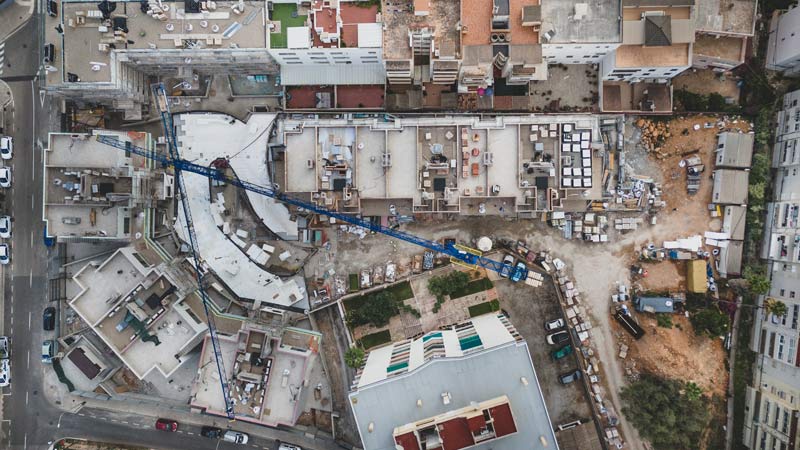
Therefore, it is not a subjective decision by the operator:
The type of flight determines that we are in a specific category, and within that category, in scenario STS-01 if its conditions are met.
Differences between Specific Category STS-01 and STS-02
Within the specific category, European regulations cover two standard scenarios: STS-01 and STS-02. Although they are sometimes mentioned together, they are designed for very different operations.
STS-01
- VLOS operations
- Populated environments.
- Controlled land area.
- Risk mainly focused on people on land.
- More spatially limited operations.
STS-02
- BVLOS (beyond visual line of sight) operations, where we may need observers with us.
- Sparsely populated areas.
- Longer distances and greater technical complexity.
- Risk focused on navigation, linking and airspace management.
In summary:
- STS-01 is associated with controlled urban flights.
- STS-02 to more extensive technical operations, such as linear inspections or extended flights.
They are not equivalent or interchangeable scenarios.
Requirements for flying in the specific STS-01 drone category
In order to operate legally under the specific STS-01 drone category, AESA establishes a series of clear requirements that affect both the operator and the pilot.
From 1 January, a C5 drone is an essential requirement for STS-01.

Operator requirements
- Be registered as a UAS operator and be declared as an operator (which is not the same as being an operator).
- Submit an STS-01 operational declaration via the AESA online portal, provided that the operation fits exactly within this standard scenario.
- If the operation does not fully comply with STS-01, an operational declaration alone is not sufficient. In that case, it will be necessary to apply for a specific operational authorisation, normally accompanied by a risk assessment using the SORA methodology. The authorisation may relate to:
- One or more operations (‘ConOps’ concept of operation).
- The approval of a LUC.
- Have operational procedures in place that are appropriate for the scenario, such as:
- Have a valid EARO for a specific category
- Make a flight plan with ENAIRE PLANEA when flying drones in Mallorca (as in my case), or with the contact provided in the information bar that appears when you click on the area where you want to fly on the Enaire drones map.
- Operations manual, which is an internal document of the operator containing:
- Operating procedures in accordance with STS-01.
- Management of the controlled land area.
- Emergency procedures.
- Operation in VLOS.
If you do not have one, you can also request a quote from me to have one made for you.
- UAS documentation: you must be able to prove that the drone meets the requirements for the scenario. Although it is not always requested in the field, it is part of the required documentation:
- Manufacturer’s manual.
- Identification of the UAS.
- Operating configuration suitable for STS-01.
- Civil liability insurance, compulsory for specific categories:
- Coverage appropriate to the type of operation.
- It must cover damage to third parties.
- Operation assessment and planning. For each STS-01 flight, you must have a formal document or operational record, but it must exist:
- Advance planning of the operation.
- Identification of the controlled land area.
- Confirmation that the operation complies with STS-01.
Pilot requirements
- Valid UAS operator number
- Specific theoretical and practical training for specific category STS-01 and certificate issued by a recognized entity.
- Knowledge of the European and national regulatory framework.
- Ability to manage controlled ground areas and security procedures.
- Keep operations strictly within the limits of the scenario.
AESA reminds operators that the operational declaration does not exempt them from liability: operators declare that they comply with all requirements and may be inspected at any time.
What documents should I bring with me on the flight?
Before operating under STS-01, it is not enough simply to have a compatible drone and a trained pilot. It is also important to have the necessary documentation ready to demonstrate that the operation falls within this standard European framework.
STS-01 permits operations in specific category, within the pilot’s visual line of sight, over a controlled land area and in a populated environment, provided that the relevant conditions are met. Therefore, prior to each flight, it is advisable to review the documentation relating to the operator, the pilot, the aircraft and the area of operation.
Checklist of recommended documents for STS-01
Documentación del operador
- Registration as a UAS operator.
- Operational Declaration STS-01 submitted to AESA, where the operation falls within this scenario.
- Operating procedures tailored to the type of operation.
- Preliminary assessment of the controlled land area.
- Contingency and emergency plan.
- Third-party liability insurance, where applicable depending on the activity and operation.
Pilot documentation
- The relevant theoretical certificate for standard European scenarios.
- Accreditation of STS practical training.
- Identity document.
- Evidence of familiarity with the UAS used.
- Knowledge of the operator’s operating procedures.
Drone documentation
- Class C5 marking.
- EU Declaration of Conformity.
- Manufacturer’s manual.
- Direct remote identification details, where applicable.
- Registration and configuration of the UAS before flight.
- Check the condition of the batteries, propellers, firmware and safety systems.
Documentation of the operation
- Prior consultation regarding airspace.
- Review of the ENAIRE Drones map.
- Check for UAS restricted areas, restrictions or active warnings.
- Demarcation of the controlled land area.
- Measures to prevent unauthorised persons from gaining access.
- Prior communication or coordination, if required by the area.
- Pre-flight safety briefing.
This greatly facilitates any inspection or control.
Operating under STS-01 is not simply a matter of ‘having permission to fly’. It involves demonstrating that the operation has been properly planned, that the scenario complies with the regulations, and that effective measures are in place to manage risk.
For this reason, before planning an operation in an urban environment, it is advisable to review all the relevant details: the type of drone, the flight zone, the necessary documentation, the pilot, any restrictions and the procedures involved. This preliminary review can help to avoid mistakes, delays and legal issues.
¿No tienes claro si puedes operar bajo STS-01?
Si necesitas revisar si tu operación encaja en la categoría específica de drones STS-01, si tu documentación está preparada o si necesitas adaptar tu caso a la normativa europea, puedo ayudarte a analizarlo antes de que presentes una declaración o planifiques el vuelo.
Categoría específica de drones STS-01
¿Qué es la Categoría específica de drones STS-01?
La Categoría específica de drones STS-01 es un escenario estándar europeo que permite realizar operaciones con drones en entorno poblado bajo condiciones concretas. Para operar en este escenario, el operador debe presentar una declaración operacional ante AESA y cumplir los requisitos técnicos, formativos y operativos aplicables.
¿En qué se diferencia la STS-01 de la categoría abierta?
La principal diferencia está en el nivel de riesgo y en las condiciones de operación. La categoría abierta está pensada para vuelos de menor riesgo, mientras que STS-01 permite operaciones en zonas pobladas siempre que se cumplan requisitos más exigentes de seguridad, formación, documentación y control del entorno.
¿Qué diferencia hay entre STS-01 y STS-02?
STS-01 está orientado a operaciones VLOS en entorno poblado, es decir, dentro del alcance visual del piloto. STS-02 está pensado para operaciones BVLOS en entornos escasamente poblados, normalmente con observadores del espacio aéreo y condiciones operativas diferentes.
¿Necesito autorización de AESA para volar en STS-01?
No necesitas una autorización individual si la operación encaja exactamente dentro del escenario estándar STS-01. En ese caso, lo que debes presentar es una declaración operacional a través de la sede electrónica de AESA.
¿Qué formación necesito para pilotar en STS-01?
Para pilotar en STS-01 necesitas formación teórica específica, formación práctica conforme al escenario, el certificado correspondiente emitido por una entidad reconocida y estar registrado como operador UAS cuando corresponda.
¿Qué dron puedo usar en STS-01?
El dron debe cumplir los requisitos técnicos exigidos para el escenario STS-01. Esto incluye el marcado de clase correspondiente, la documentación del fabricante y las limitaciones operativas establecidas para este tipo de operación.
¿Es obligatorio tener procedimientos operativos escritos?
Sí. Como operador debes disponer de procedimientos operativos documentados y adaptados al escenario STS-01. Estos procedimientos deben incluir la evaluación del entorno, las medidas de mitigación del riesgo, la gestión de la zona terrestre controlada y los protocolos de emergencia.
¿Desde cuándo es obligatoria la STS-01 europea?
Desde el 1 de enero de 2026, los escenarios estándar europeos sustituyen definitivamente a los antiguos escenarios nacionales, como el STS-ES-01. A partir de esa fecha, el escenario de referencia pasa a ser el STS-01 europeo cuando la operación encaja en sus condiciones.
¿Puedo hacer trabajos profesionales con STS-01?
Sí. La Categoría específica de drones STS-01 está pensada para operaciones profesionales en entorno urbano o poblado que no encajan dentro de la categoría abierta, siempre que se cumplan todos los requisitos normativos y operativos.
¿Qué pasa si no cumplo exactamente con los requisitos del escenario?
Si la operación no encaja completamente dentro de STS-01, no puedes acogerte a ese escenario estándar. En ese caso, deberás solicitar una autorización operacional específica basada en una evaluación de seguridad, normalmente mediante metodología SORA.
If you have any questions about this category and the things you need to fly safely, please do not hesitate to contact me or ask your question below.
Bibliography: https://www.seguridadaerea.gob.es/sites/default/files/A-DUAS-FOR-CO01_v4_Formacion.curso_.conversion.teorico.practico.pdf