

In the aeronautical sector there are different types of drones, with their different components and accessories. This world is constantly evolving with changes occurring almost on a daily basis. This world is constantly evolving with changes that seem to have no ceiling, so I can’t help but think that this has only just begun.
Every day we see drones with new features that make life easier for professionals in the aeronautical and imaging world.
I always say that the better the shot you get, whether it’s photography or video footage, in situ, the easier it will be and the less headaches you will have during the final editing. This is why it is important to have a team of guarantees and to know the scene in which we find ourselves in order to get the most out of it.
If we do a simple internet search on the number of different types of drones on the market we can get a small idea of how immense this world is today.
Moreover, in just a couple of years, all this has exploded in the form of the appearance of new UAS models, since many brands that were not dedicated to this sector have seen the opportunity and have started to work on it.

What is a drone
Before explaining the types of drones and getting into the subject, it would be good to define what a drone is.
The word drone refers to an unmanned aerial vehicle (UAV).
With the entry into force of the decree on December 31, 2020, drones were renamed from RPAS (remotely-piloted aircraft system) to UAS (unmanned aerial system).
Many changes of initials to define the same thing, i.e. an unmanned aircraft that is capable of maintaining a controlled and sustained level of flight on its own and is powered by an internal combustion, electric or jet engine.
What is the range of a drone
The range of a drone will depend on the type of drone and the type of license or permit it has and the country where it is flown.
Civilian drones, the ones that most people fly, if we fly them by ourselves without the help of an extra partner, who is professionally qualified, we can only fly them at a distance of 500 meters or within visual range (VLOS), according to the Royal Decree 517/2024.
Types of drones
Now it is. Before talking about the types of drones I wanted to start with the basics first, and that meant I had to define what a drone is. Once defined, we will make a classification of drones depending on:
- Of the structure
- On its use
- Depending on their weight
- According to current regulations
Drones by structure or type of wing rotation
This is the most important classification as it will determine the type of drone we are using. We can say that there are 2 types of drones depending on the structure with which they get the propulsion to start the flight:
Fixed-wing drones
Fixed-wing drones are those that take advantage of the aerodynamics of their design and morphology to soar. Its wing does not move and is integrated into the body of the aircraft. Its appearance and structure is the same as that of an aeroplane, with its wings being the main reason for its lift in the air.
Rotary wing drones
This is where we will place UAS or, from the point of view of the movement of their propellers, also called multirotors. They are the best-selling drones on the market for their versatility and ease of use (if you dedicate many hours of flight time to them, that is).
These drones achieve lift and lift in the air through the movement of their propellers, which are driven by motors on each of their arms.
They are the most stable drones as their integrated geolocation system allows them to stay at the X, Y, Z point in space without having to continuously correct their position with the remote control.
I will tell you more about the use of these drones below, in the civilian use of drones.

Types of drones by number of propellers
Before buying your drone you must be clear about what you want it for, so knowing the requirements to fly a drone, the open category where you will fly first, will help you to buy the drone you really need, no more and no less.
Tricopters
As the name suggests, this multirotor has 3 propellers. The two front motors rotate in opposite directions and the rear motor acts as a servo motor, giving stability to the flight.
Quadcopters
In all likelihood, this is the best-selling and most common drone on the market. The 4 motors are positioned in a square rectangle (positionally speaking), giving the drone great stability during flight.
I have owned several drones while growing up in this profession and honestly the DJI Mavic 2s “all-rounder” drone, in my opinion, is the best drone to date in terms of quality-performance-price ratio. This is the drone with which I officially fly for Javier Gómiz.
But I’m already eyeing the new DJI AIR 3. Check out its new features in a hyper-comprehensive article I’ve put together.


Hexacopters
Hexacopter drones, as the name suggests, have 6 motors and 6 propellers. Due to the high stability of these drones and the possibility to install heavier cameras with a high resolution, these types of drones are becoming the choice of large companies to make super film productions and important recordings.
Another advantage, and perhaps the most important, is that if one engine should fail, it could land without any problems with the help of the remaining engines.
Octocopters
The octocopters are another type of drone, the last of the classification, with 8 arms and 8 motors, it is the most stable multirotor of all the ones I have told you about. The only drawback could be the difficulty in flying it in small spaces, as the larger components are heavier and it becomes more difficult to control.
I have found a very cheap octocopter drone without camera that you can assemble yourself with a bit of skill.
Coaxial
The defining characteristic of this type of drone is that it has at least 2 motors on each arm, making it a more powerful type of drone. As a result, coaxial drones can transport objects or climb with less difficulty and more speed. They are widely used in the professional field to take high quality photographs.
Drones according to use
Drones make our lives much easier nowadays, and that is the information and knowledge that I want to convey in this javiergomiz.com website to raise awareness, as drones also have many detractors.
Drones can be put to many uses, and these uses have led to the creation of a new classification of drone types according to their use. These uses will be very different depending on the field in which they are used: civilian or military.
Military use of drones
The first use of drones had a military origin, they were then called unmanned combat aerial vehicles (UCAVs). The first use of a UAV for military purposes was in 1849, which had nothing to do with today’s drones, but was a carrier balloon.
In World War II, drones also played a role, but it was not until the end of the 20th century that they did not operate by radio control with full autonomy equipment. It was not until the Gulf War or the Bosnian War that they showed their true potential, not least because they were cheaper fighting machines and did not endanger the lives of pilots.
These types of military drones are not only used in warfare and combat, but also have other, more interesting and more civic uses.
The army can make use of these military drones to search for missing persons, since they can access places that are difficult to reach and, taking advantage of this virtue, they can be of great help in general in any type of catastrophe, assessing damage to surfaces or structures that may endanger people.
Drones are also used by law enforcement agencies for traffic control at demonstrations. More specifically, the drones used by the police are the Megadron EH216 model, also known as EHang 216 AAV.
The Megadron EH216 is an autonomous aerial vehicle that can carry two people, flies at 130km/h and weighs up to 600kg. It also has the capacity to carry payloads.
Civilian use of drones
It is these types of drones that we are talking about, the ones we are interested in.
The drone has become a device that has made our daily lives much easier, as its implementation in many fields has made it possible to offer an immense range of services with the drone.
Drone photography and video
For many image professionals, photographers and videographers, used to the same old perspective and the same old photos, drone has changed our lives.
Being able to change the hitherto unique view and perspective means that the range of possible photographs has increased by 3 different perspectives of more than 180° each. Plus the infinite planes we can achieve with the 120 metres height we can reach in the open category.
From there, the limit is your creativity.
Among the most common drone services are:
- Drone photography
- Video drone
- Panoramic photography
- Drone filming and video advertising
- Drone weddings
- Drone for real estate
Airport services
Services Although the use of drones is strictly prohibited in airport areas (not in CTR areas, as long as we have a permit to fly), the airport authorities have implemented the use of special types of drones to control birds on the runway. At Southampton Airport, their presence was reduced by 74%, thereby reducing the likelihood of aircraft accidents.
Civil works services
For these purposes, certain types of drones are used to carry out three-dimensional modelling or surveying work. Using photogrammetry as a technique (which I want to do a post on and talk about in more depth), the shape, dimensions and position in space of any object can be accurately studied and defined. For this purpose, some types of drones with LIDAR sensors are often used. strong (Laser Imaging Detection and Ranging) or high-resolution cameras.
They are often used for road construction, building construction, monitoring the progress of a construction site, calculating volumes of earth to be moved and other uses. They are also used by real estate agents who want to detail the measurements of a property or land for sale.
Also the control of the transport of fragile or dangerous materials where a helicopter had to be hired, thus reducing economic costs and avoiding endangering human lives.
Visual inspection with the drone of structures such as wind turbines, which would be dangerous for people to do in situ, in addition to the cost savings in logistics.
The great role of drones in construction in general is very clear.
Drones and the environment
Drones can carry different types of cameras, including thermal imaging cameras. Thanks to this camera we can monitor, for example, the current state of a landfill, thus controlling its hot spots or humidity. We can also control and monitor environmentally protected areas or control fires in summer.
In agronomy, agricultural drones are used, which are notable for their ability to carry out photogrammetric work. These agricultural drones are used to take care of and control crop fields, minimising labour and saving money, as they can even carry out fumigation tasks, which is why they are also called fumigation drones.
Drones for racing and stunt use
These types of drones can track targets as they move at (some) considerable speed, such as FPV drones (first person view).
Used for their small size and high speed, they can perform acrobatic stunts and sudden changes in trajectory and speed, making them the perfect choice for recording video footage of racing cars, motorbikes, bicycles or any vehicle in general.
If you are not very familiar with the world of FPV drones, with their many accessories and parts; you are looking for an FPV drone assembled and ready to fly, I tell you that DJI has released two pearls that are a real blast, the DJI FPV that comes with a “joystick controller” or the crown jewel of the DJI FPV, the DJI Avata.
This drone is the most similar to the FPV racing drone as it has 4 protected propellers, is flatter and its dimensions are much smaller than the DJI FPV.
Drone types according to weight
The classification of a drone according to its weight or MTOM (maximum take-off mass) is also very important as other classifications will derive from it. The classification of a drone by weight will lead to a classification of drones by category, and this in turn will lead to a classification of drone types according to their regulations:
- C0: drones under 250 grs.
- C1: corresponds to drones weighing between 250 grams and 900 grams.
- C2: for drones up to 4 kg.
- C3, C4, C5 and C6: corresponding to drones between 4 kg and less than 25 kg.
Types of drones according to their class marking
This classification is based on the entry into force of the current regulations imposed by EASA (European Aviation Safety Agency) on January 1, 2021, by which this agency classifies drones according to their maximum take-off mass, also called MTOM, plus other characteristics.
And as of January 1, 2024, all drones coming on the market already have their class marking visible on a sticker on the outside. They must be perfectly detectable through remote identification.
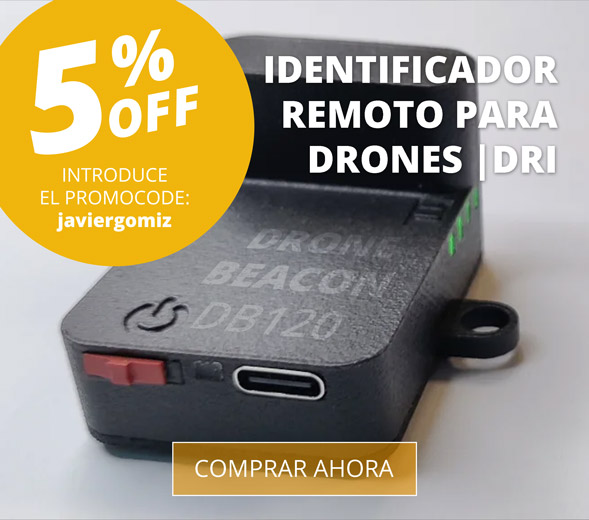
If you have a Legacy drone (built before January 1, 2024), you may have to attach a remote drone identifier to it. Check before and do not fly illegally, you could be fined! In the link I have provided you will be able to get a 5% discount on your purchase.
In Regulations (EU) 2019/947 and (EU) 2019/945, classes ranging from C0 to C6 are named, the latter two being incorporated in Delegated Regulation (EU) 2020/1058, to be used in European standard scenarios.
Class C0
Class 0 drones, also called unlicensed drones, are drones that can be flown without a license, are the most basic and have fewer restrictions, basically because of their weight and must meet the following requirements:
- Its MTOM cannot be less than 250gr.
- The flight speed should not be more than 19m/s.
- They have a maximum height limitation from the point of take-off of 120m.
- It should be designed to be non-harmful to persons and easy to handle.
- The manufacturer’s instructions must appear inside the packaging.
- They are powered by electricity.
In this category we have drones such as the Mini 2 and Mini 3, which reach a maximum speed of 13m/s and can be limited to a maximum height of 120m. It must be said that to date these types of drones still do not carry the CE class marking, even though they meet all other requirements.
Class C1
There are already 2 drones that carry class marking (class 1) is the great MAVIC 3 (Mavic 3 Classic) and the DJI AIR 3 and, these have opened “opened the can” of class marking. Class 1 drones must meet the following requirements:
- Your MTOM must be less than 900gr.
- Its energy in case of impact must be less than 80J.
- The flight speed may not exceed 19m/s.
- Height limitation of 120m.
- It must be electrically powered.
Differences from Class 0
- These are drones that require operator registration by the pilot to fly them.
- Unique serial marking for the drone.
- It must have an RTH (return to home) system, which is a system whereby the drone returns only to the point from which it started or where it was last indicated as the place of return.
- Mandatory to have direct remote identification and network remote identification system.
- It must have a geo-awareness system.
- Low battery warning system.


Class C2
Aeronautical operations conducted in subcategory A2 shall be conducted with a minimum distance of 30m from persons not involved in the operation and may be conducted with Class 2 drones which comply with the following requirements:
- Maximum flight altitude limited to 120m.
- It must be electrically powered.
- Have a unique serial number.
- It must have a direct remote identification system and a network remote identification system.
- Obliged to have geo-awareness system.
- Low battery warning system for the UAS and control station.
- An example would be the Mavic 3 CINE and Mavic 3 Enterprise.
Differences from class 1:
- Your MTOM must be less than 4kg.
- They must be equipped with a low speed system of 3m/s maximum except if it is a fixed wing UAS.
- They must have night lighting.
- It must be equipped with a data link protected against unauthorised access by persons not connected to the equipment.

Class C3
Class 3 drones shall be flown away from urban environments and people and shall be those drones that meet the following requirements:
- It must have a geo-awareness system.
- Flight height limitation of 120m.
- Obligation to be equipped with a data link protected against unauthorised access by persons not connected to the equipment.
- Have a unique serial number.
- It must be electrically powered.
- These types of drones are required to have a direct remote identification system and a network remote identification system.
- It has to be equipped with night lights for visual localisation at night.
- Have a low battery warning system for the UAS and control station.
- Equipped with a low speed system of maximum 3m/s except if it is a fixed-wing UAS.
- Night light equipment for control during night flight.
Differences from the previous class 2
- Its MTOM must not exceed 25kg and a characteristic dimension of less than 3m.

C4 Class
These types of drones are similar to class 3 drones and differ from them in the following ways:
- Its weight or MTOM must be less than 25kg + payload.
- May not have automatic flight mode, except for a flight stabilisation system and without any direct effect on the trajectory, for assistance in case of loss of connection between the aircraft and the transmitter.
- Intended for model aircraft
Class C5
Class 5 drones are intended for VLOS flights in specific category for standard STS 01 scenarios (controlled land area in urban environment), and must provide for the following:
- Your MTOM must be less than 25kg.
- They cannot be fixed-wing drones unless they are captive aircraft.
- Mandatory provision of flight altitude information.
- They have to be equipped with a low speed system with strong limit, <5m/s.
- It must be equipped with a system to recover the aircraft in case of disconnection with the transceiver, also called RTH (return to home), whereby the drone returns only to the point of departure or the last place indicated as the place of return.
- It must be equipped with a data link protected against unauthorised access by persons not connected to the equipment.
- Power supply and operation of the aircraft through electricity.
- Remote identification system (e-ID).
- It must have a unique serial number.
- It must have a geo-awareness system.
- It must have a control station and a low battery warning system.
- Must be required to carry flashing lights for night flights.
- It must have a system of flight limitation and access to certain areas of airspace and a corresponding system for notifying the pilot of this impediment.
Differences from the previous class 4
- It may be a Class 3 UAS which after installation of a certain kit with accessories can be upgraded to a Class 5 UAS.
Class C6
Class 6 drones intended for operations in BVLOS Specific Category or STS 02 standard scenario must meet the following requirements:
- Your MTOM or weight before take-off must be less than 25kg.
- Drone types with a low speed mode limiting the speed to 5m/s maximum.
- It must have a flight altitude measurement system to avoid exceeding flight limits.
- It must have an RTH (return to home) system, whereby the drone recovers the exact location of the pilot.
- Electric power supply system.
- Obligation to have a unique serial number.
- It has to have a direct distance identification system (e-ID).
- It must have a geo-awareness system on the drone.
- A low battery warning system must be installed.
- If it has a system of flight limitation in specific areas, it must have a system for notifying the pilot of such limitation.
- Mandatory control light system for night flights.
Differences from the previous class 5
- The maximum horizontal speed in relation to the ground that can be reached is 50m/s.
Drone types by propulsion
Drones can be classified by the way in which they are supplied with energy that makes them able to move or propel. Energy can come through:
- Electric batteries.
- Petrol.
- Or we can talk about hybrid drones, which can be understood as using both batteries and gasoline. These hybrid drones increase performance compared to electric drones. Hybrid drones can hover for up to 4 hours, reach over 80-90 km/h and carry a payload of up to 10 kg.
After this extensive but necessary explanation, you are probably starting to get an idea of what drone to buy, but do you know the requirements you need to fly a drone in Spain? It is very important that you read this article.
Did you know about the different types of drones? Personally, when I started in this world, I had no idea how huge it is. Let me know if you have any questions, I’ll read you in the comments.

2 Responses
¿Es cierto que si un drone tiene cámara se necesita licencia A2, aunque sea un drone que pese menos de 250g? Sólo los drones sin cámaras no tienen estas restricciones. Al parecer, el decreto contiene tal disposición.
Hola MJ,
Si un dron tiene cámara y no está catalogado como un juguete por el fabricante, lo que tienes es que registrarte como operador de dron.
La licencia A2 va en relación al peso de tu dron y al riesgo que entraña la operación en la categoría abierta.
Un dron de menos de 250gr tiene muy pocas restricciones ya que puedes volar hasta en ciudades (hay que mirar las posibles restricciones que tengas según la localización) y no te obliga a sacarte el A2 para volar.
Espero haber respondido a tu pregunta.
Un saludo,
Javier